Member spotlight: Mona Kavolius Monroe
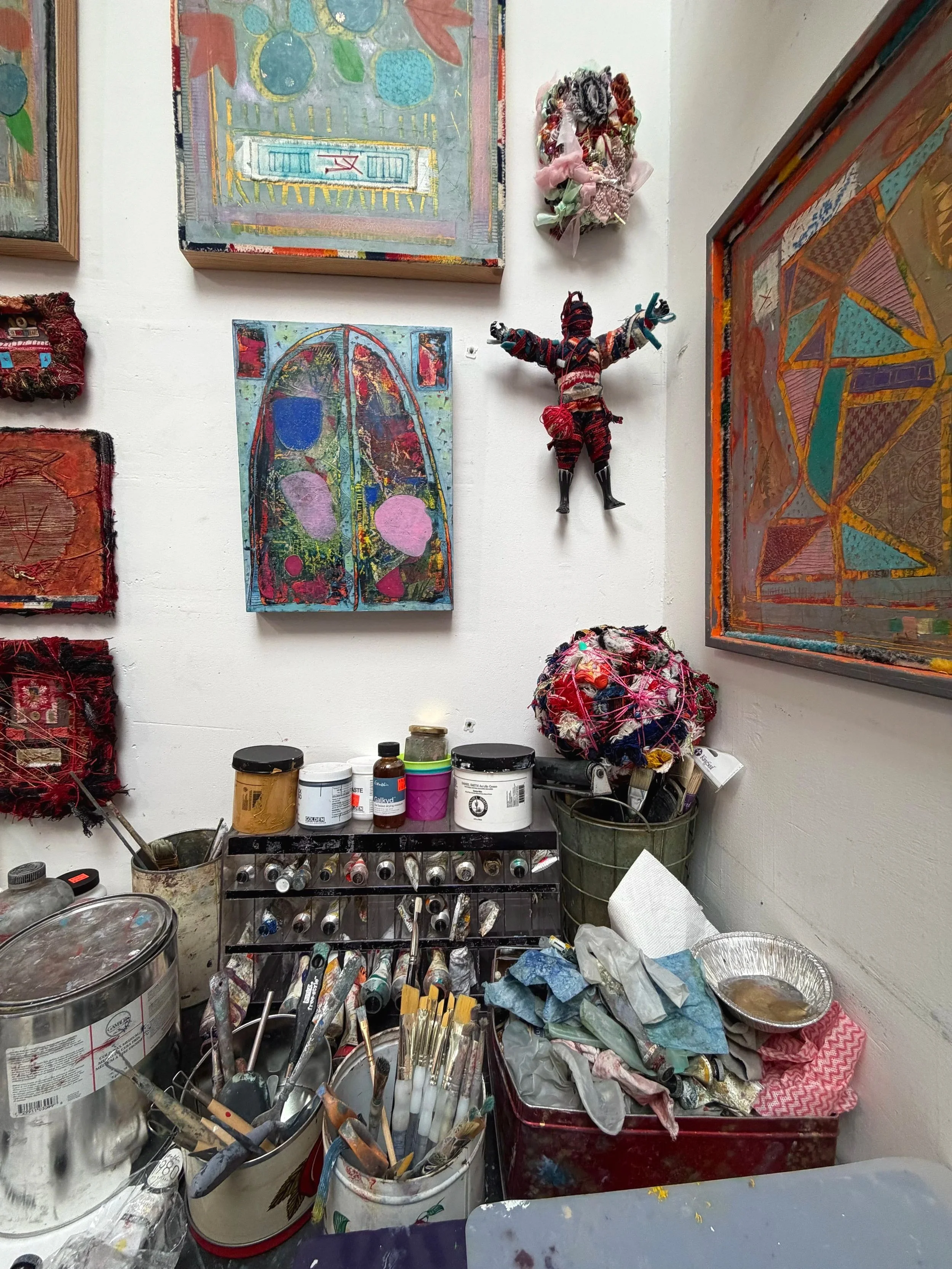
Mona’s corner of the studio
B: Were you always making art from an early age? Where did you grow up and how did you start making work?
M: I've always done art. I was born in New York City, then lived in New Jersey for a while. When I was seven, I moved to Connecticut. I remember being in school and having kids ask me to draw their things for them. So, I've always drawn.
My father was musically gifted. He studied opera at Juilliard for a while. He would go and paint in the basement. Jackson Pollock was in, so he would do these kinds of drip things. My mother, I think she was an interior designer for a while.
So, yeah, I've always drawn, and they (my parents) nurtured it too. So I always had stuff to draw on and papers. I remember my mother taking me around to museums. She had worked in New York. She was a career person before she married my father. So she would always take me to the city and we would go to the museums and things like that. And I think it was always expected that I would study art or do something with art.
B: Do you have any early memory of seeing something that gave you aesthetic chills?
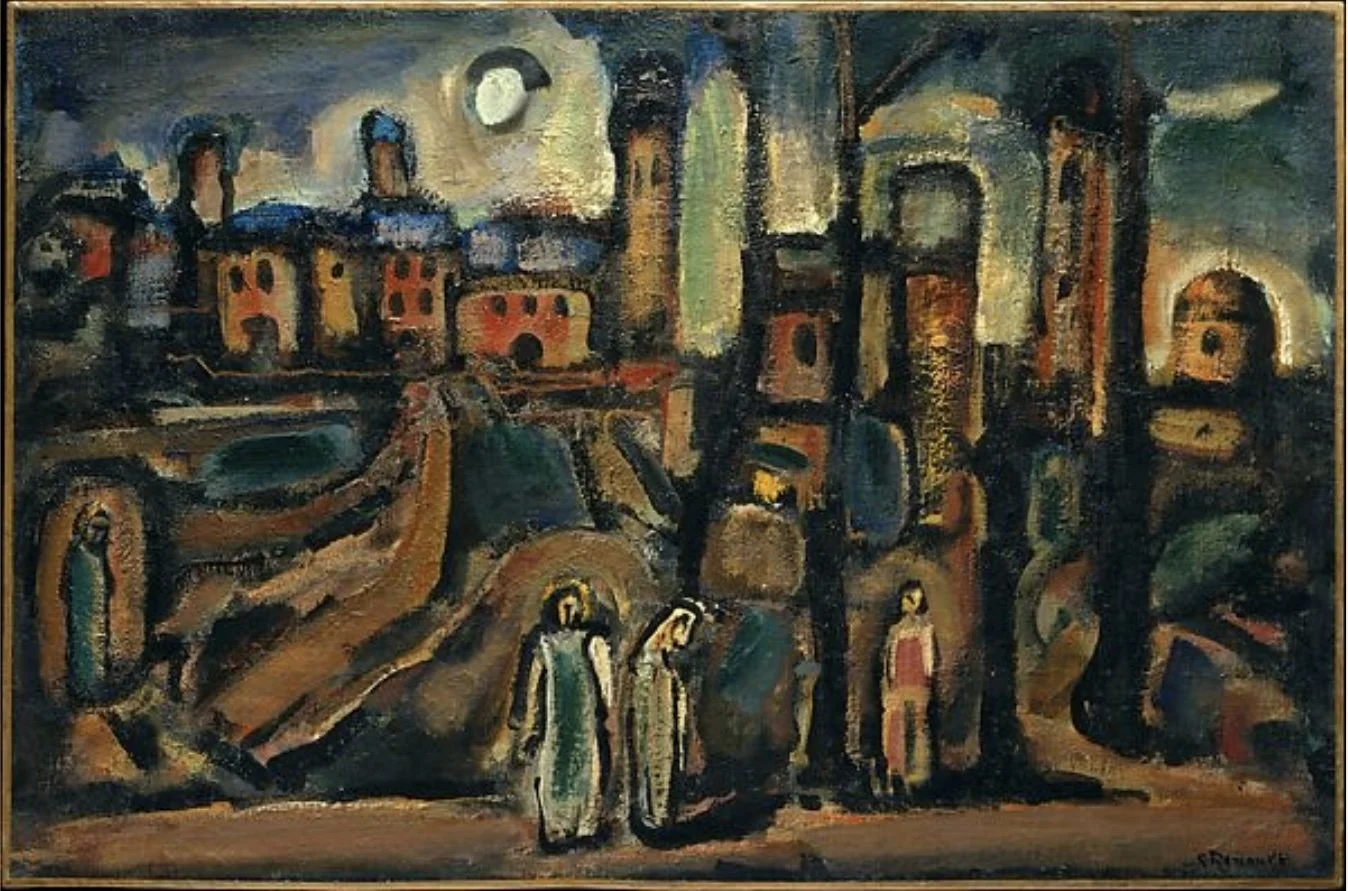
M: Like when people see a painting and they cry? Well, I liked Toulouse Lautrec, Rouault…I like the black lines around the bright colors and the real thick paint. I liked Klee, Kandinski, and things like that. I still have little art books that my mother bought me when I was a kid. Even when I was in high school, I was interested in kind of doing some sort of assemblage stuff. I remember getting these wooden crates and filling them with stuff from the dump, filling them with shiny stuff, glitter and stuff like that.
Image above: “Twilight” by Georges Rouault, 1937
B: So when you went to high school and beyond, was art sort of your direction?
M: Yeah, I didn't know exactly what I was going to do with art…for a while I thought about fashion design, but then I realized you had to learn to sew and I didn't like to do that.
B: What years would have been that?
M: I was born in 1950, so high school was like 67, 68, something like that. I remember thinking I'll just be a starving artist, whatever that may be. I just wanted to paint, all I was thinking was I was going to be an artist, whatever that was.
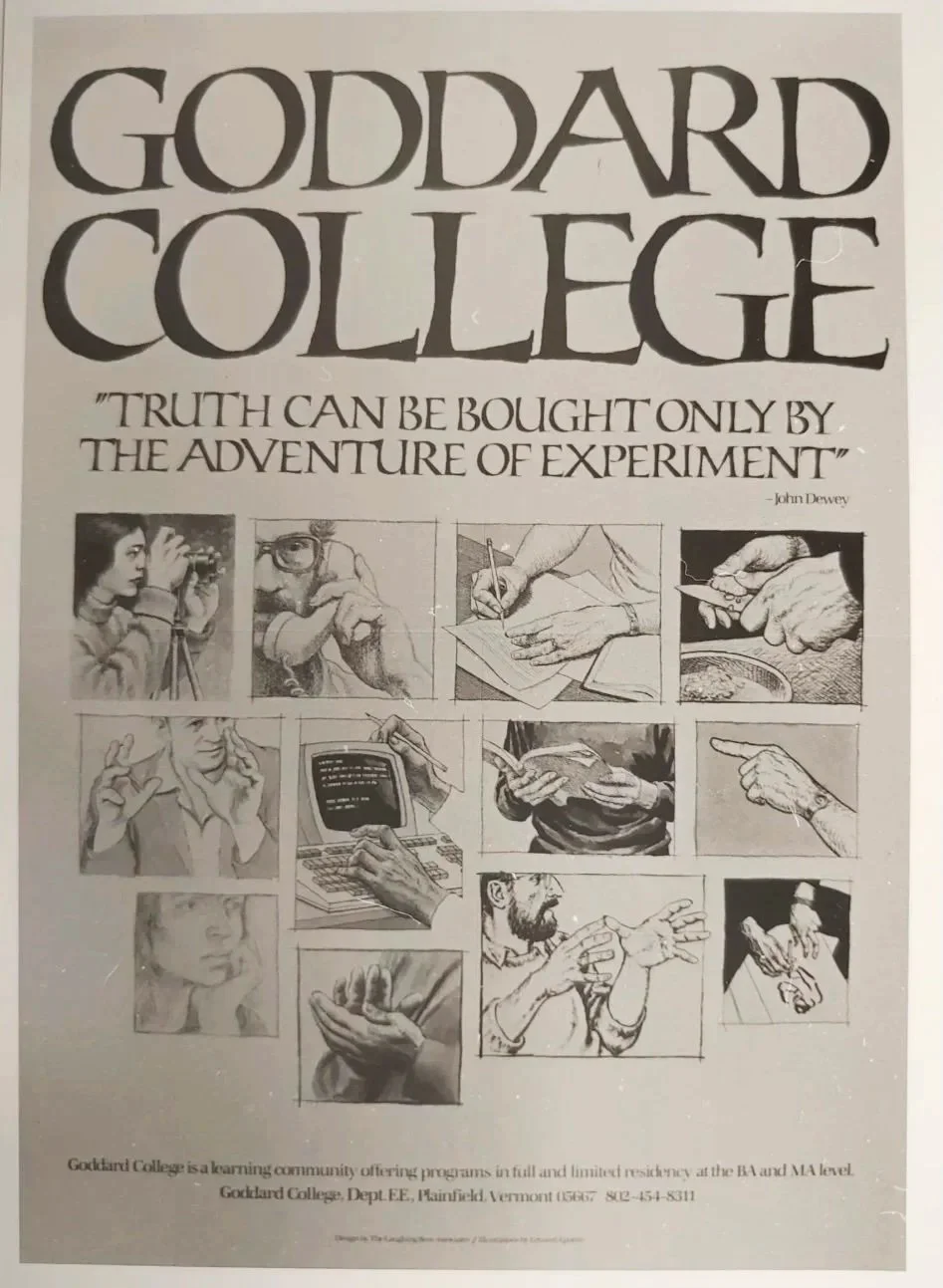
So, when I graduated high school, I went to the Moore College of Art and Design, which is in Philadelphia. I had a bad breakup and decided to transfer and finish up at Goddard College in Plainfield, Vermont. Goddard College was an experimental school. I was doing printmaking then, and I had a great teacher. It was a pretty freeing experience, but, you know, it was not very disciplined. I had some discipline (from Moore) going in there–I'd done drawing, painting, color theory, design, life drawing and modeling. We also had to learn calligraphy. We used vintage ink pens on white poster paper and if we made a mistake or got a drop of ink, we had to white it out and sand it down. It was terrible, but I did have all those background courses.
B: How did you know about Goddard College?
M: I don't know. It was in the zeitgeist, kind of. Yeah, you know, and it was back east and you kind of heard about things like that.
B: Did you have like a crew of printmakers you were hanging with?
M: Yeah, but I also knew people outside of art too. I had a group of writers that I kind of knew. One year, I was in a dorm, and they gave us back the money we paid in for board so that we could learn to provide for ourselves. So I was the bread maker, so I made bread for the dorm. I ground the wheat berries to make the flour.
Image: Goddard College Brochure
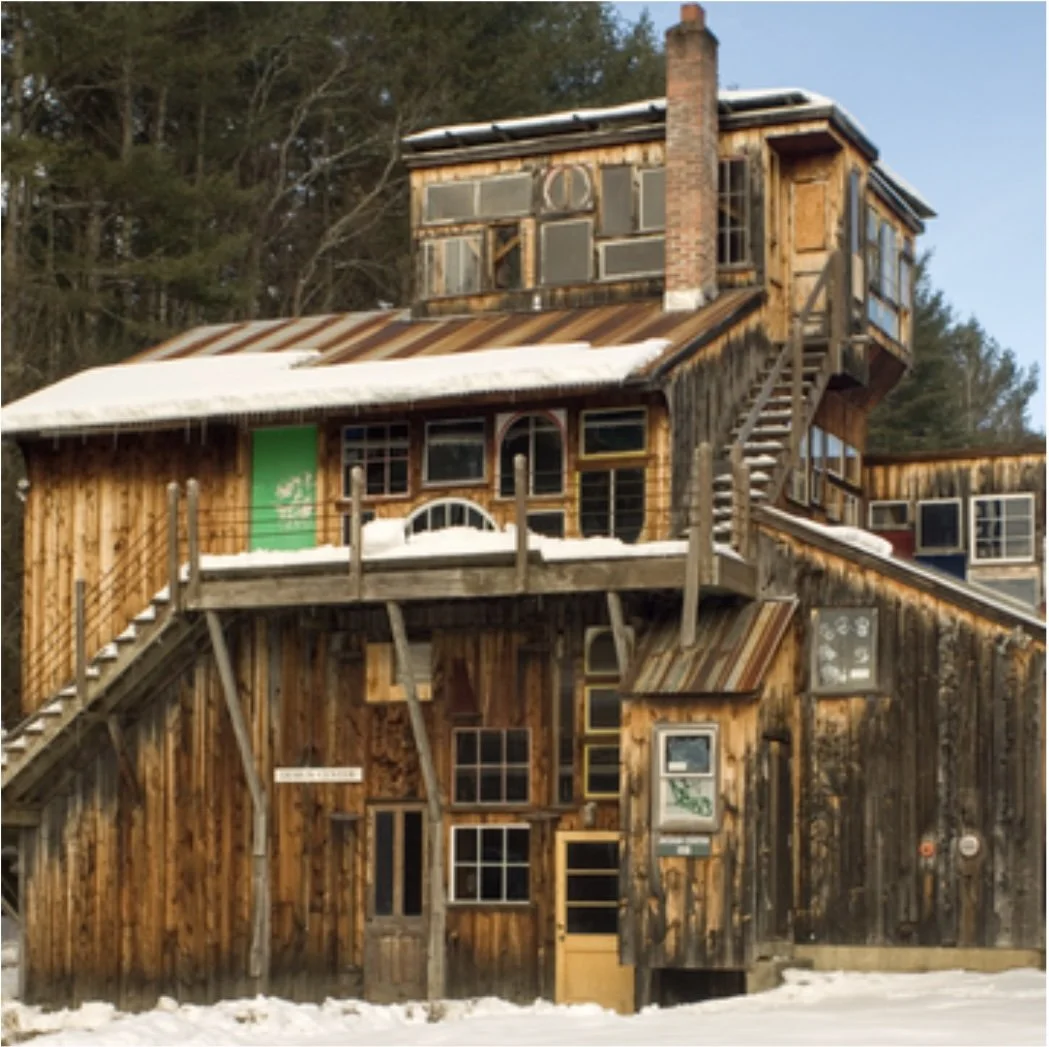
Students in the experimental architecture school at Goddard College designed and built improvisational structures from salvaged materials (Photograph by Curtis B. Johnson, C. B. Johnson Photography)
M: Other people bought a cow. There was this old Vermont woman who showed them how to cut up the cow in the dorms. I didn't do this part, but they were up there cutting up the cow and there were classes going on at the same time. There was a photography professor who came in and was just in shock and turned vegetarian because it was so horrible.
It was a really very, very hippy place. There was a local family just called man, woman, and child. They just lived around the area, you know? And you had to be careful because they would come into the dorms and if you were having a party or something, they would put acid in the punch.
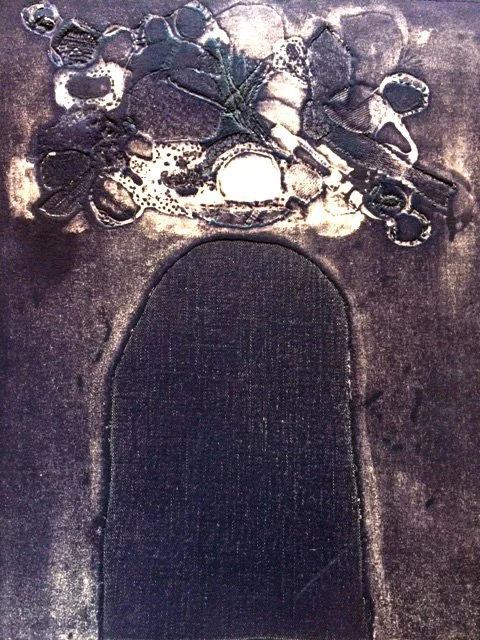
Images: Collograph Print by Mona from 1971
B: Wow. So, what did your work look like at that time?
M: I was interested in Rothko, at that time. I did some etchings, I did collagraphs, I did monoprints. The etchings weren't really successful because I was trying to use barely contrasting colors. I had big copper sheets, and I etched squares in them. I had iridescent inks, and I was trying to print them so that the squares were kind of barely there, kind of Rothko like. Other prints had a lot of portals in them. I used this big shape, and I still use it sometimes, this sort of big portal shape.
B: How did you decide to come West, and why Oregon?
M: I met another guy and we actually wound up getting married, it was a very short marriage, but after I graduated, we just heard that Oregon was a beautiful place and we wanted to come to Oregon. I forget exactly what year that it was, but it was a really bad economy here. There were no jobs. So I worked at an A&W root beer shop. I was a carhop, then I got to make root beer in big vats.
Then I got a job at Chase Gardens, which was a greenhouse, and I thought it was important for me to try to work somewhere that had some beauty.
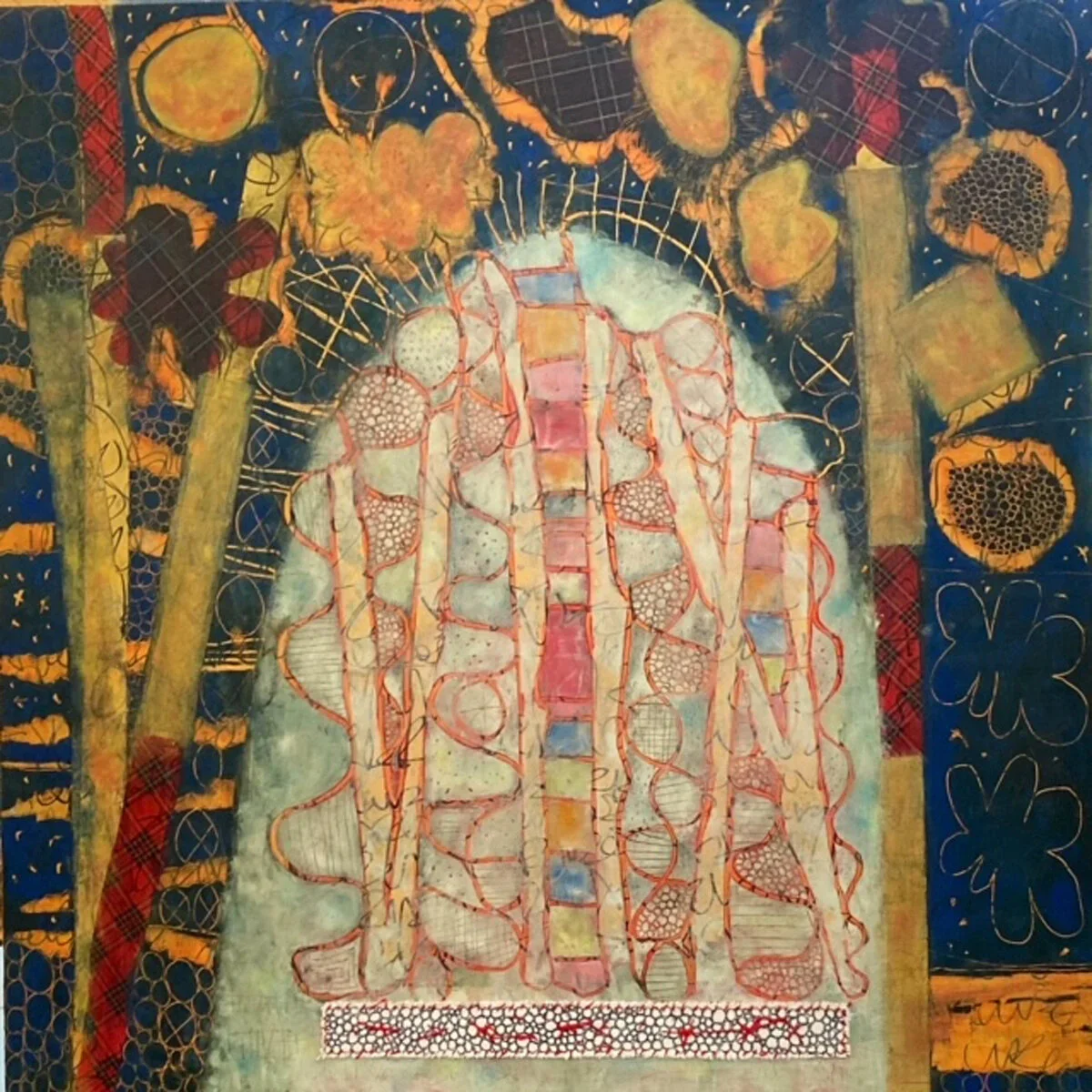
Image: “Looking into the Abyss and it Looks Back at You” Oil on wood from 2021
M: I got a job as a rose coordinator, which means that you would pick up the cut roses, wrap them in plastic, and put them in water in a very hot greenhouse. I think I made $1.25 an hour or something like that, but there was a woman there doing personnel work. Her name was Norma, and she needed an assistant. So, I applied to be her assistant, which was my “in” to human resources. And then I got to be Norma because Norma went to outer space.
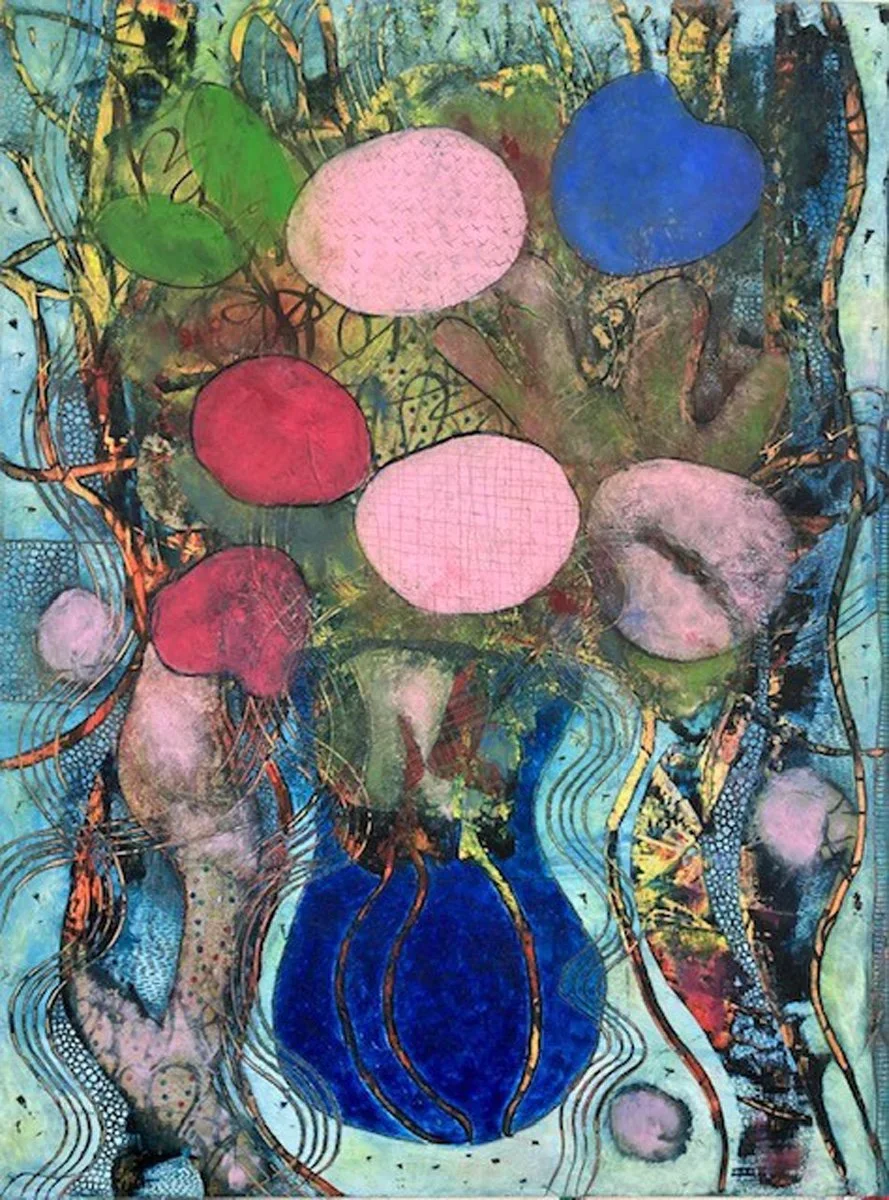
“Another Bouquet of Flowers Arrived Every Day” Oil and mixed media on wood 2022
B: Really?
M: Maybe. We're not sure. In Eugene at the time, there was this cult that was around there, and people had to give up all their worldly possessions, and then they were somehow gonna go to outer space or something. So anyway, Norma went to outer space and I got her job.
During this same time, I got divorced and I met Bill and we eventually moved to Corvallis and I got a job as the personnel and operations manager at a Lippman store.
M: I think that women sometimes work in spurts. When I had kids (1st son Max was born in 1984, Zach in 1988), I would figure out something I want to do, and I spend a really concerted effort doing it. It would be either late at night or on the weekends. Of course, I encouraged my kids to draw so my kids are creative too. But it was hard then to apply for shows since you had to do slides, which was really hard. So I would do things every once in a while. It was really hard to have a family and be in retail because you have to be there all the time. So, I started to look for another job, and got the job as Human Resource Director at Pacific University in Forest Grove. Bill was working at a nursery in Forest Grove. We wound up moving there and lived in Forest Grove for years and years. Being at the university was good because they had an art department, so I got to use their press there. I got to take classes.
B: So, throughout your life, it seems like you've been able to sustain your creative practice. Do you have certain rituals or things that keep you coming back to your work?
M: I've never had like a blockage or anything like that. I think I work even if I'm doing bad stuff. I just keep going because I think it nourishes me and sustains me. I'm a collector. So, I'm always looking... I'm always seeing something that I like. I collect things that I was always going to make something with, and I haven't. The last few years, I've tried to take some of those things and make something.
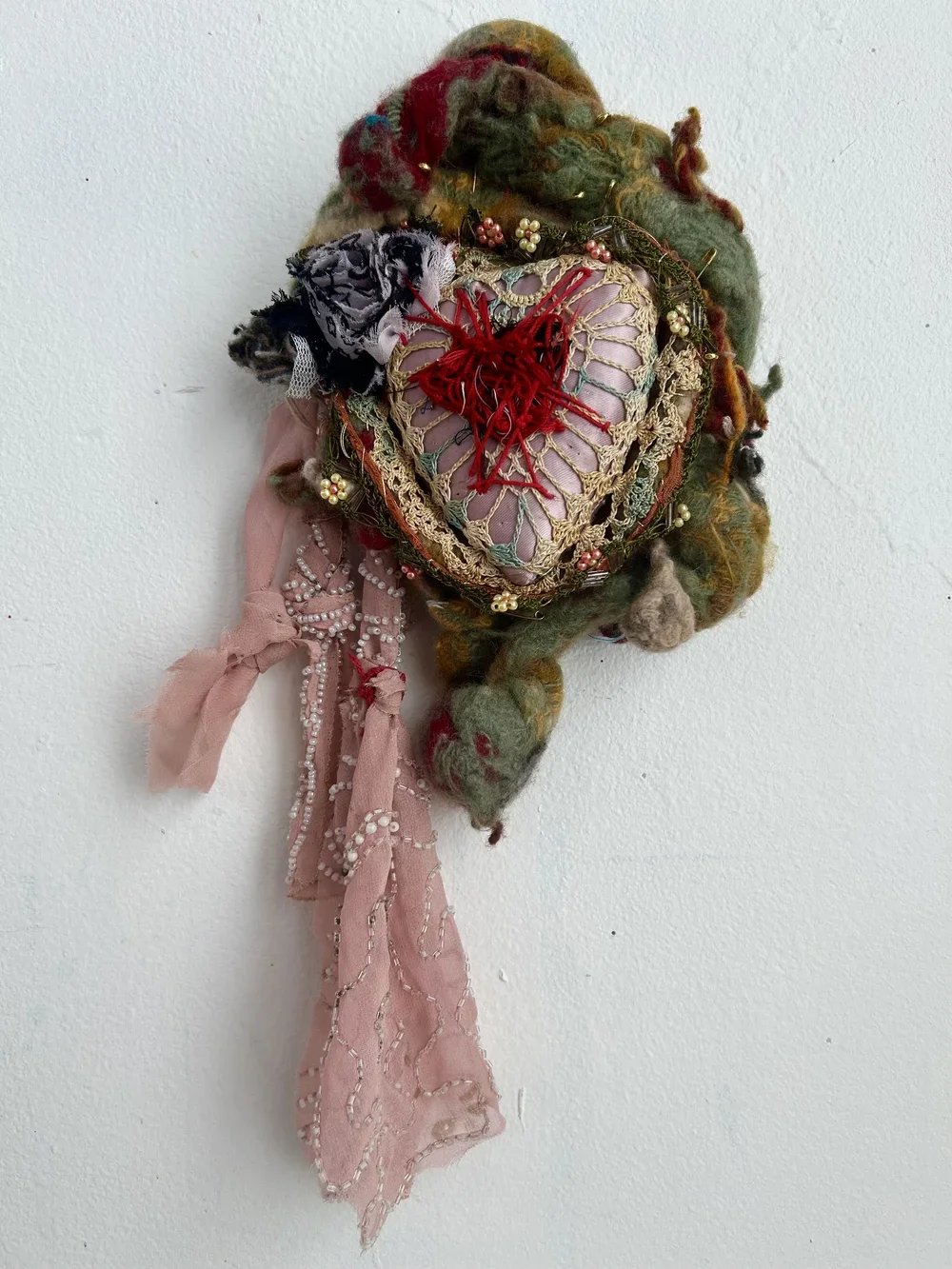
“Talisman” Vintage dress, wool, red thread, sharp things, found objects 7”x9”, 2026
B: I want to ask you about your recent work and your study with Yevgeniya Baras and The Canopy Program. How do you feel like that year of mentorship moved your work to a different place?
M: It was the exposure to different things. I knew art history, old art history and things like that. But I didn't know exactly what was happening now…but now I do. So, looking at other work–I think I learn a lot by looking. (Regarding Yevgeniya’s influence) I'm starting to work more intimate, smaller, before that, I was trying to work bigger and things like that. But, you know, her work is not very large. It's kind of small and intimate. And that kind of appealed to me.
It actually has enabled me to talk about my work easier. I’ve noticed that in the last few months. It was always really hard for me to go to an opening or things like that. But now I go and I walk up to people and I can talk about my work. I don't think I could have done that without the (Canopy) program.
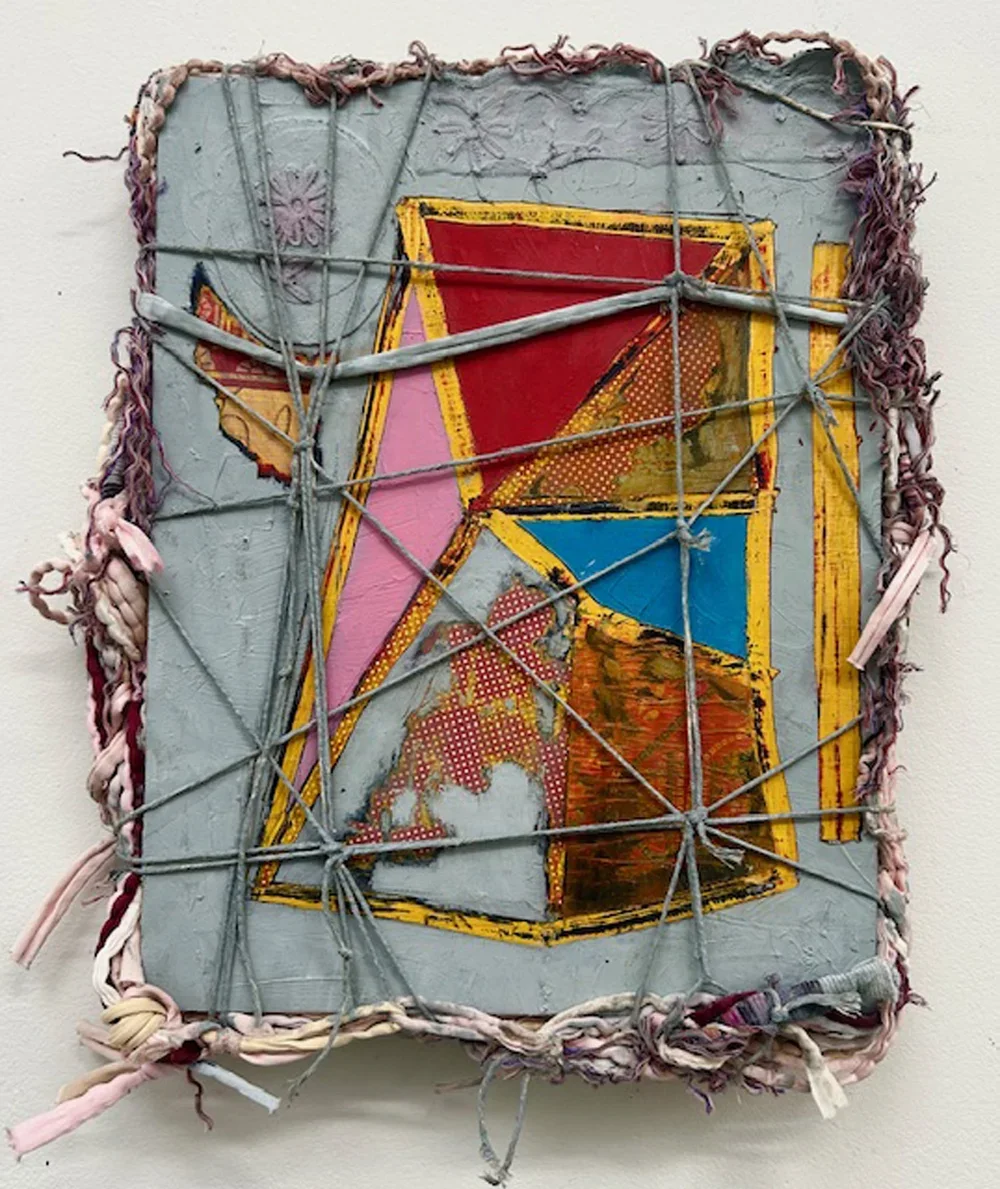
“Kaunan” Oil and mixed media on wood 2026
B: Getting together weekly and listening to someone talk about their work or talking about your own work and trying to kind of hold a conversation around things that are largely visual is a good practice.
M: Yes, I think in the end, it really did something for me. Now I know where to go.
M: I was really happy when I first got this place here, because I always wanted to have a studio in Portland. You know, a place to go…and there's a boxing studio next door, which I think is really cool. I'm always thinking…I think a lot at night. I mean, art is so intertwined in my life because it has been my whole life. It's just part of me.
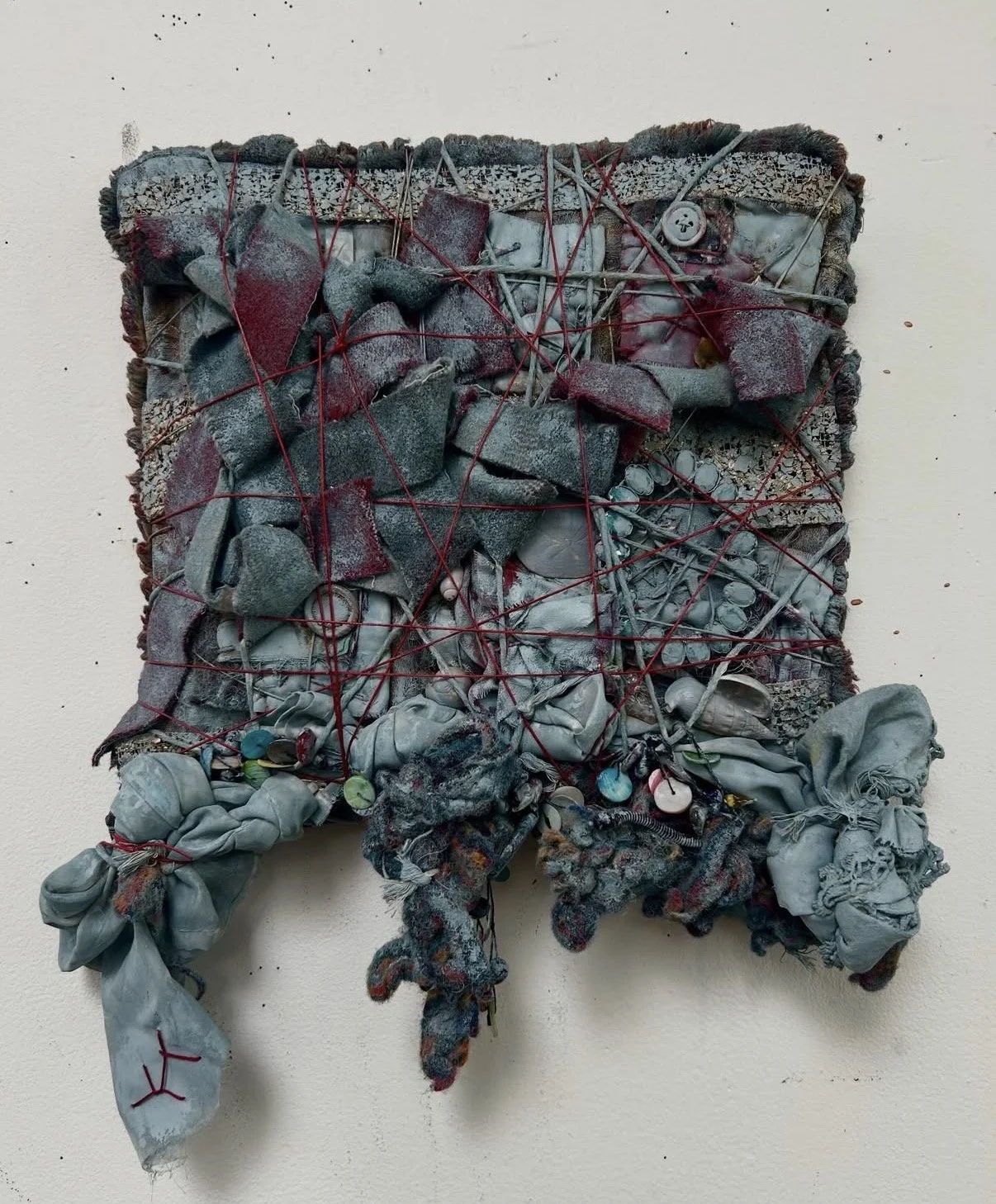
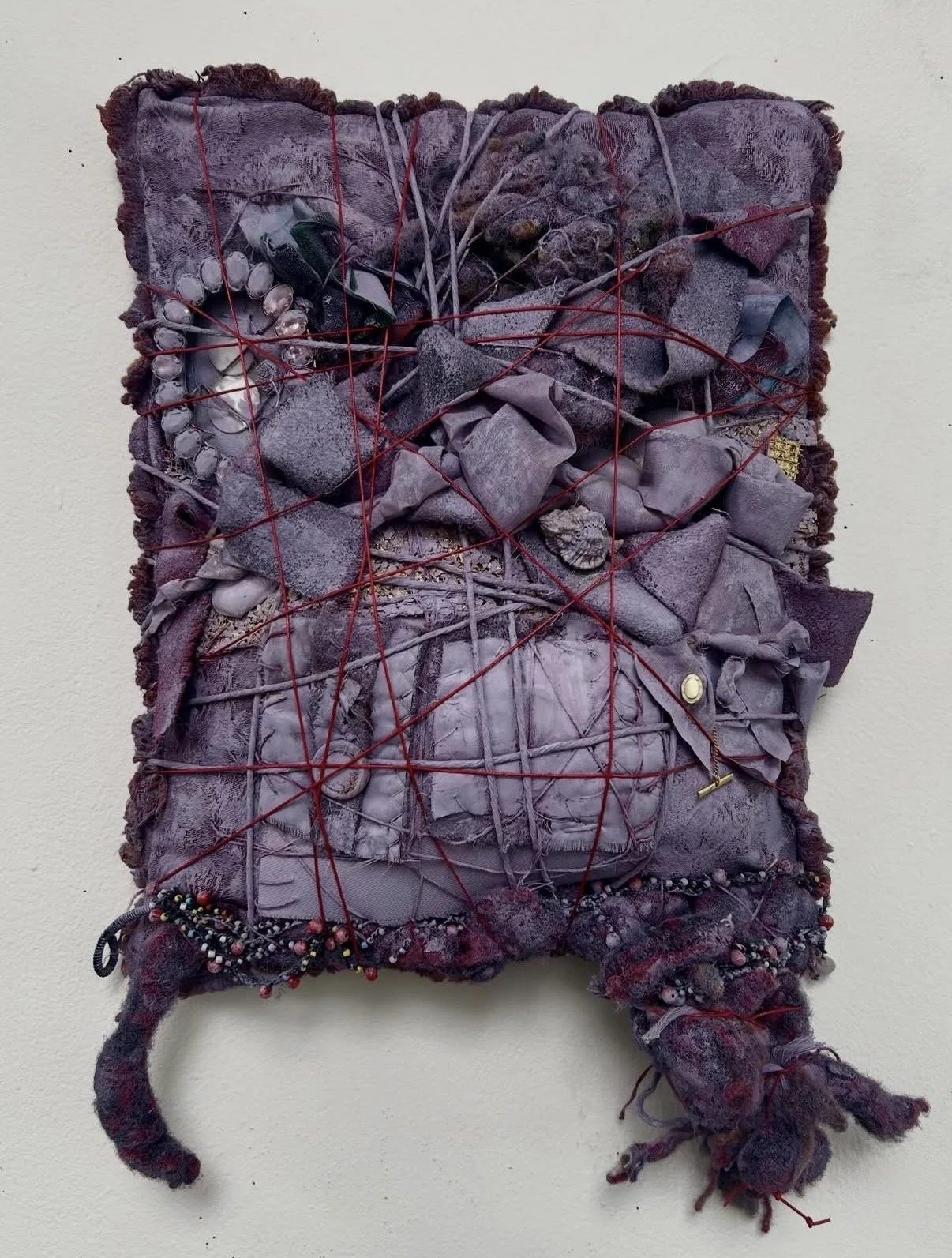
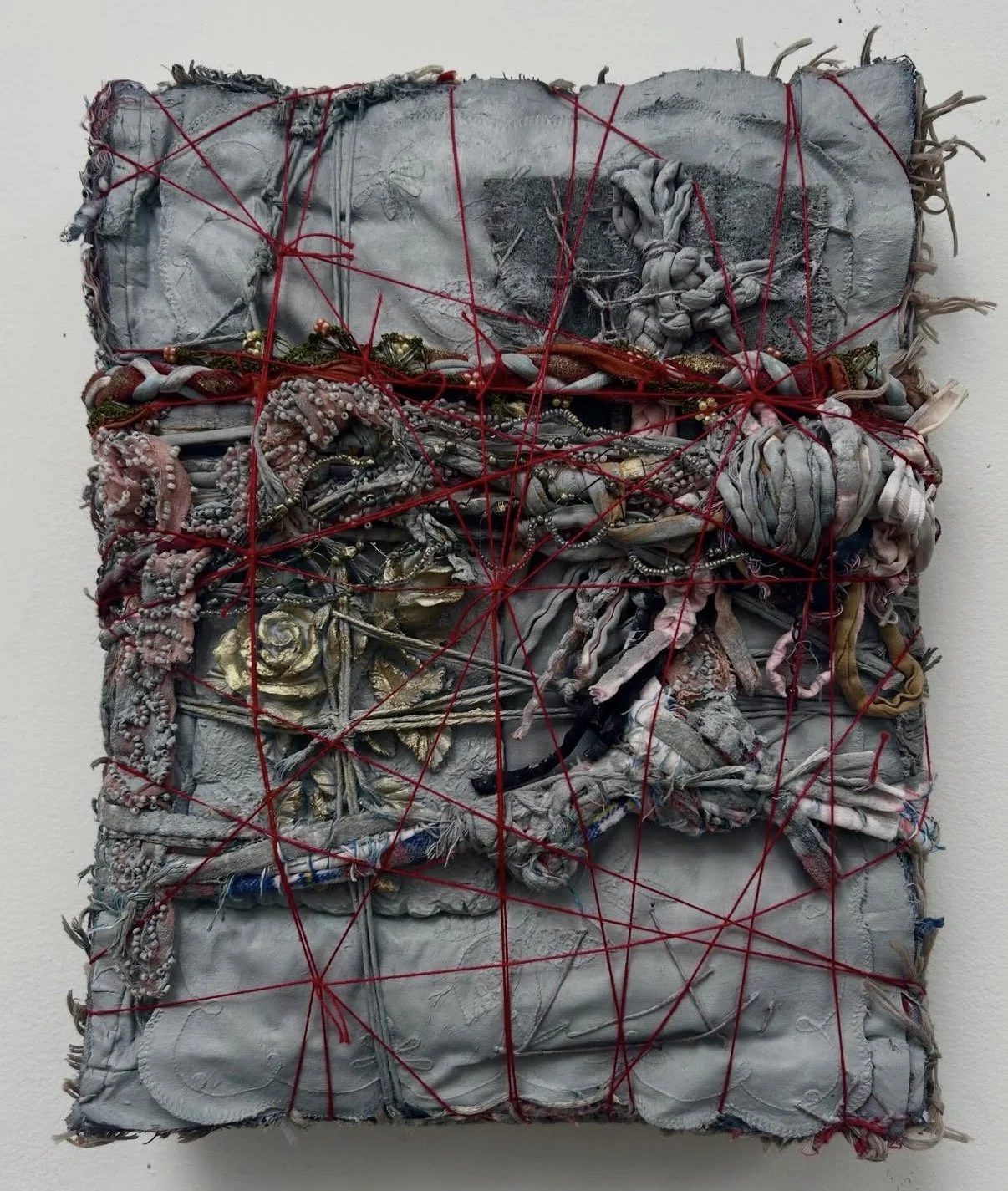
Images: Oil, mixed media on wood, 2026 (various sizes 12”x12” to 12”x14”)
B: It does seem like your work begets more work, like you inspire yourself that way. As you let things in, are you also keeping things out? How are you dealing with all the shit that's going on right now? Or is that coming in?
M: I think that being here (in the studio), and working with your hands. It's a kind of medicine. So I'll see news and things like that and try to, you know, figure out what is real and what is not real. There is the whole thing (in my work) with the apotropaic marks and things like that, the protection. You know, and I did those protective jars when I was away and things like that. And I want to make these little poppets. I've got these little brown felt figures and I'm going to sew them together and there'll be little pockets and you can put things in them and burn them.
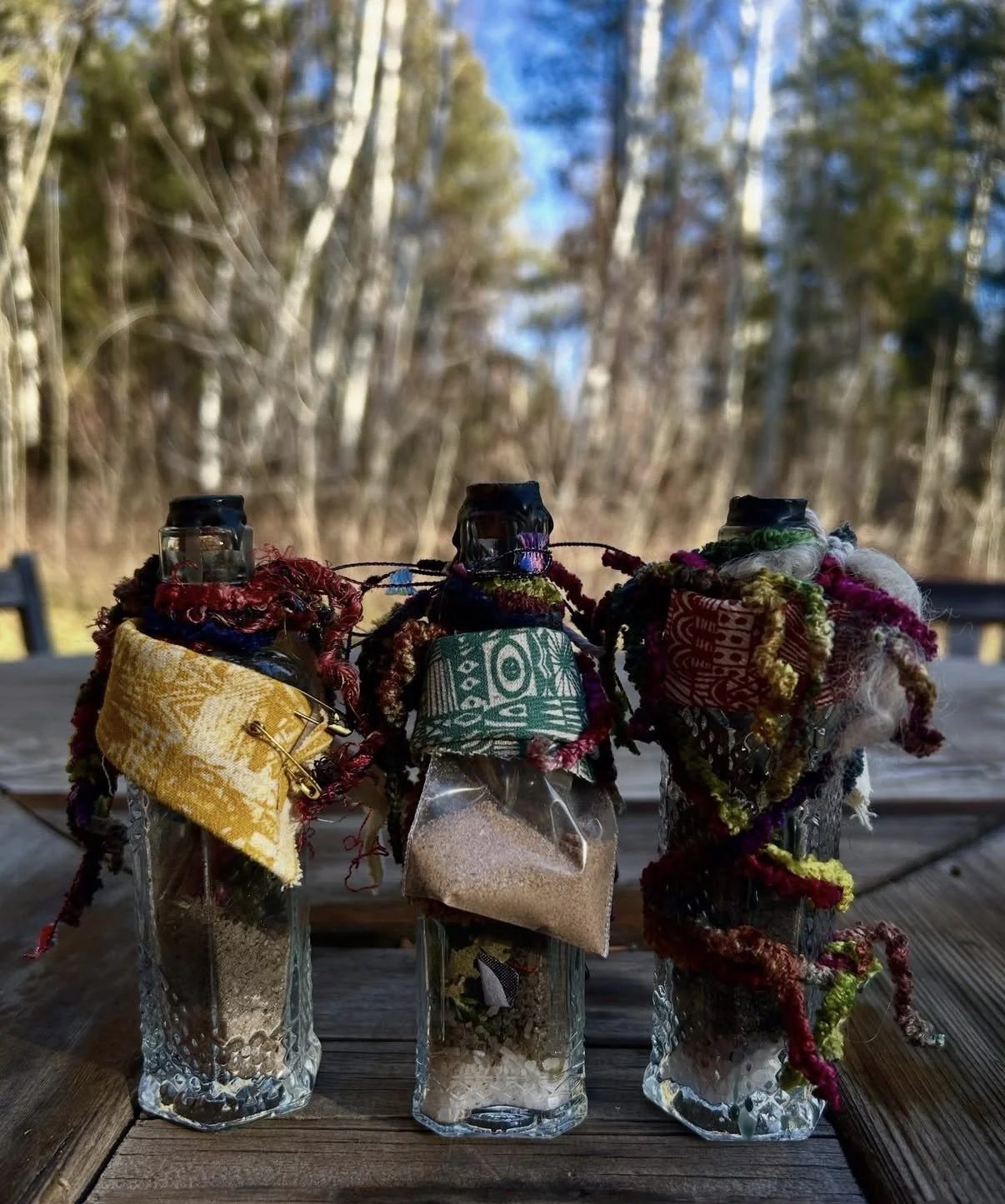
Protection Jars made in Mona’s summer studio in Alta, WY 2025